
Many test-takers find SAT reading questions difficult. One of the main reasons is that — unlike math questions — reading passages can seem open to interpretation. As a result, multiple answers often feel reasonable.
The good news is this: just like a math question, every reading question does, in fact, have only one truly correct answer and three truly wrong answers.
Of course, the College Board (the organization that makes the SAT) must design its reading questions in this bulletproof way. A hyperbolic (but useful) way to think about it: if the College Board didn’t design its answers like this, test-takers who disagreed about the correct answer would protest and sue non-stop, and the College Board would go out of business!
(The College Board doesn’t want this.)
But this raises a key question: how, exactly, can the College Board design SAT reading questions so that there’s only one “lawsuit-proof” correct answer? After all, isn’t reading based on interpretation and opinion?
Part I: The College Board’s Solution (What Makes an Answer Correct)
To get around this obstacle, the College Board designs reading questions to follow a core rule: correct answers are always 100% evidenced by the text. In fact, as we’ll see, this evidence is essentially “mathematical”: every single keyword in the correct answer maps directly to the text.
To complete the lawsuit-proof system, the College Board also designs incorrect answers so that they’re not evidenced by the text in some fundamental way.
To see an example of this, let’s look at a reading question written by the College Board. Go ahead and try it yourself before reading on:
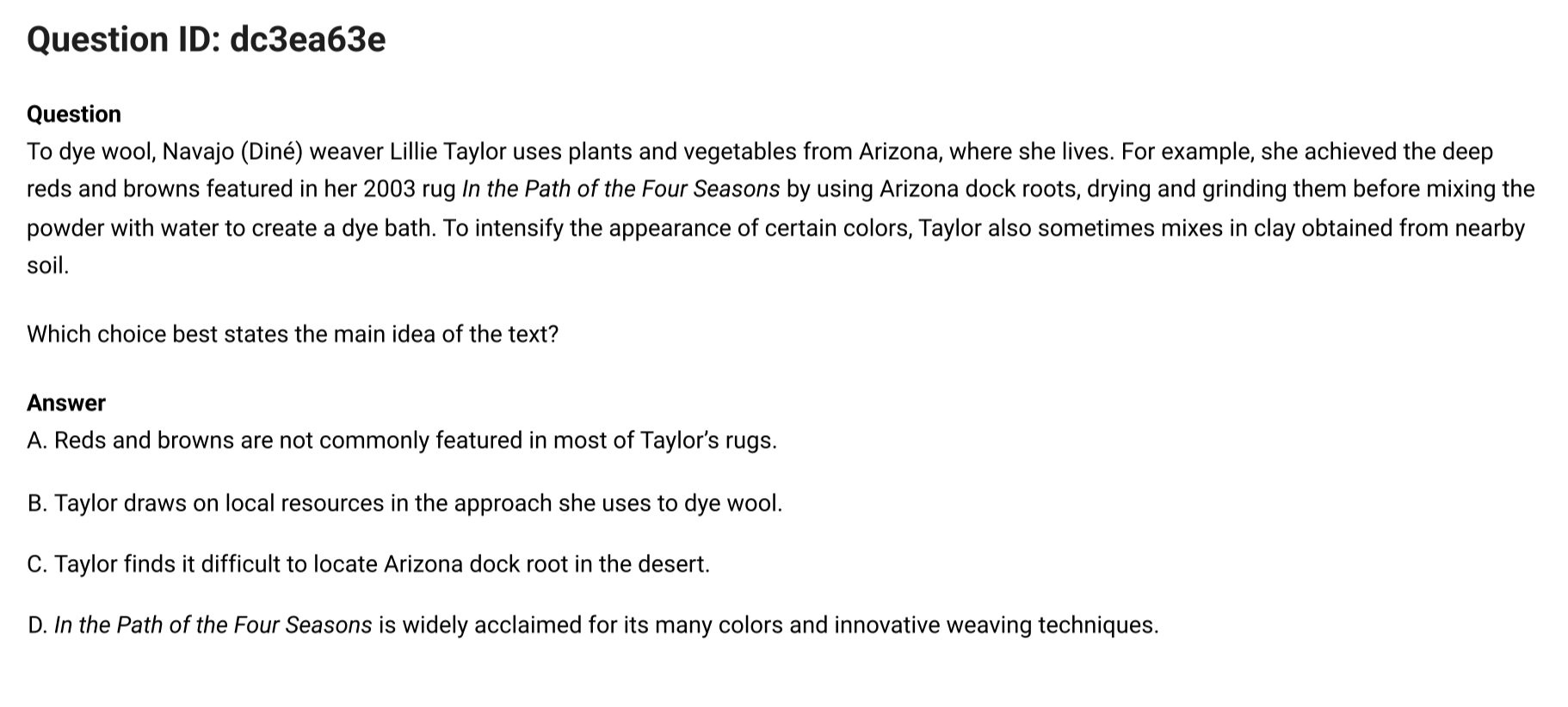
Let’s first start with the wrong answers. Notice how they’re not evidenced by the passage:
Answer (A) can be eliminated because the text never says that “reds and browns are not commonly featured” in Taylor’s rugs. In fact, it suggests the opposite by providing the example of In the Path of the Four Seasons, which had “deep reds and browns.”
Answer (C) can be eliminated because the text never mentions whether it’s easy or difficult for Taylor to locate Arizona dock root.
Answer (D) can be eliminated because the text never mentions how people reacted to In the Path of the Four Seasons. The text also doesn’t mention “many” colors; it only talks about red and brown.
On the other hand, notice how every single piece of answer (B) maps mathematically—color for color—to evidence in the passage.
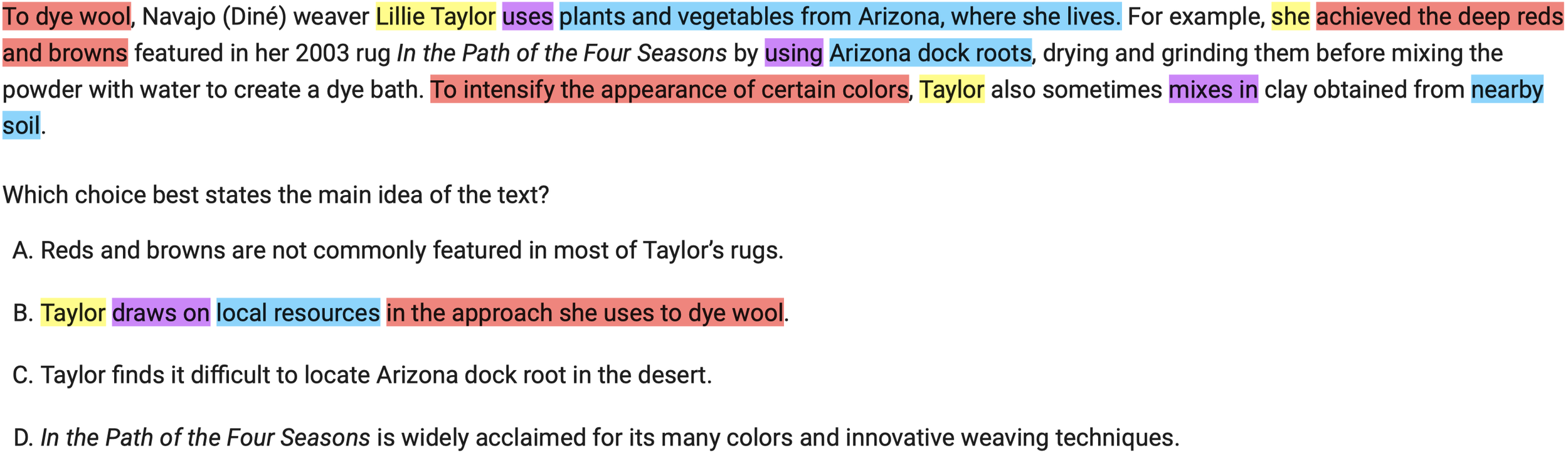
If a test-taker were to sue because they disagreed with the correct answer, the College Board would win 100 out of 100 times.
Part II: How the SAT (Tries) to Make Our Lives Hard
Now that we’ve seen what makes answers correct on SAT reading questions, you might be wondering, “Is that all there is?” After all, if every correct answer is stated or shown by the text, then SAT reading questions are basically open-book. In theory, they should be easy, and everyone should get a great score.
Of course, the SAT wouldn’t provide meaningful data to colleges if it were that easy. So, the College Board had to come up with a solution to this dilemma. That is, the College Board had to find ways to make SAT reading questions difficult for most test-takers.
They have a few ways of doing this, but these are two of the sneakiest:
They hide the fact that SAT reading is an open-book test. Specifically, the College Board writes SAT questions to make it seem like the correct answer is open for interpretation rather than being mathematically evidenced by the passage (shoutout to Mike and Patrick Barrett’s SAT Prep Black Book for pointing this out).
They include tricky answer choices. The College Board writes wrong answers with “micro-errors” to trap test-takers who don’t interrogate every word for textual evidence.
This is a powerful 1-2 punch: the SAT sets us up to think in a general, interpretive way when we read a question, then it tries to trap us with hyper-specific answer choices!
Let’s look at an example of these tactics with this question written by the College Board. Go ahead and try it yourself:
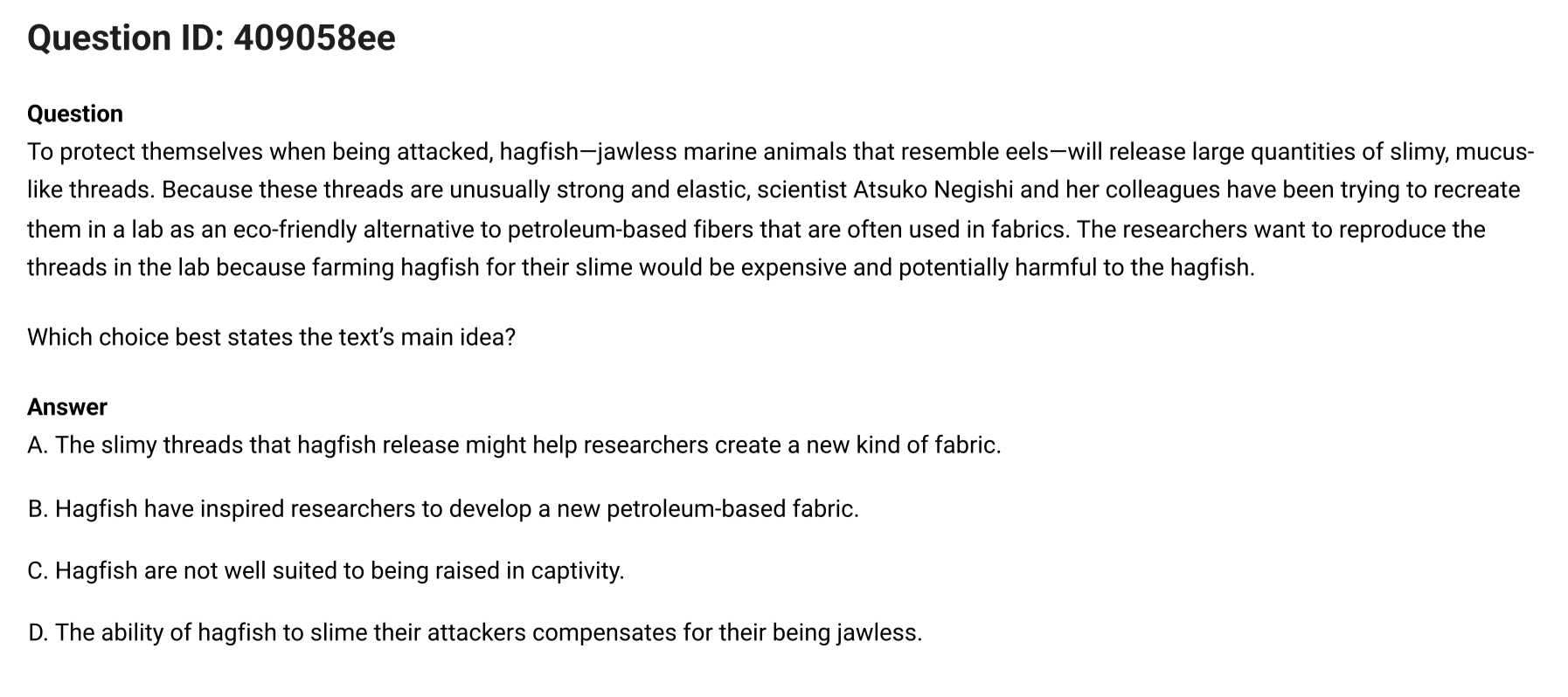
Before we review the correct answer, let’s take a moment to notice what the SAT is sneakily doing:
The question is worded in a misleading way. Specifically, by asking for the choice that “best” states the text’s “main idea,” the SAT tries to get us to think in a more general, interpretive way rather than looking for specific evidence in the text. This wording also implies that more than one answer could be reasonable.
The wrong answers are also sneaky:
(B) This answer is almost entirely correct, except for a micro-error: the single word “petroleum-based” throws it off. The text says that the hagfish have inspired researchers to develop “an eco-friendly alternative to petroleum-based fibers…” (underlined for emphasis). So, this answer ultimately goes against the text. Still, many test-takers choose this answer (or are slowed down by it) because they don’t notice the micro-error.
(C) Even if this were true in real life, it is not stated in the text, and it’s not the focus of the text.
(D) While the text says that hagfish slime their attackers, it never says that this “compensates for their being jawless.” This is also not a main idea of the text, since it’s mentioned only in the first sentence.
Now that we’ve seen what’s wrong with (B), (C), and (D), let’s examine the correct answer (A). As before, notice how each of its keywords maps mathematically to evidence:
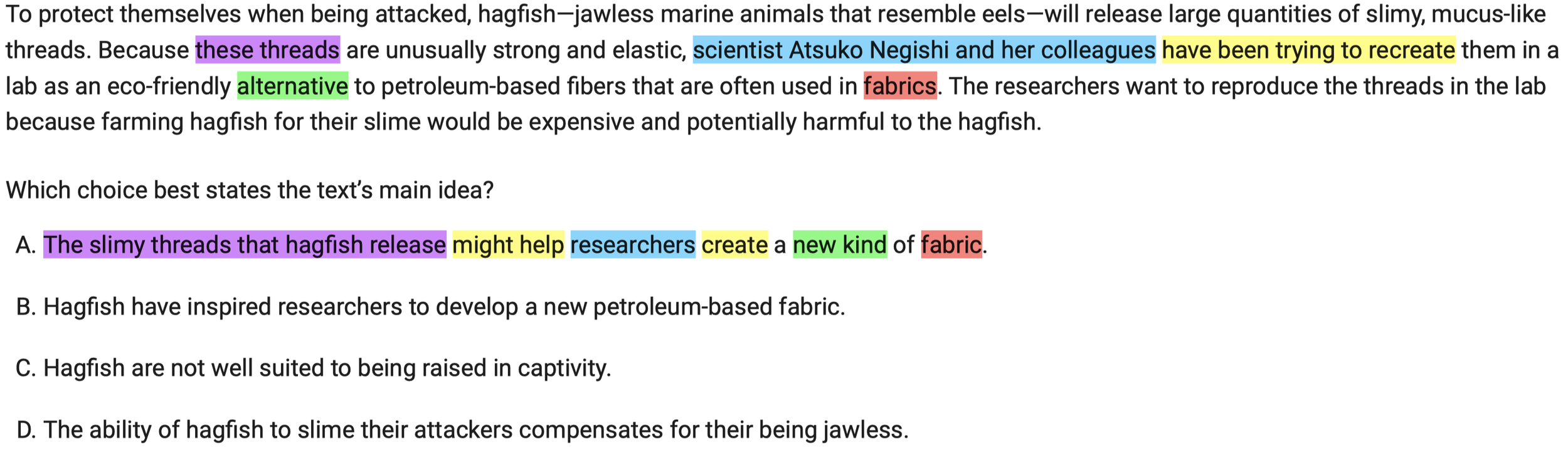
Part III: The Lawyer Mindset to Beat the SAT
Now that we know the SAT’s tricks, let’s begin reviewing how to beat them. The foundation? Our mindset is crucial when approaching SAT reading questions:
One reason why many test-takers struggle with the SAT is because they approach the test in the same way they’d approach a high school English class. For example, let’s imagine that your English class is discussing a novel. Your teacher might ask the class for the main idea of a certain passage or chapter of that novel. You raise your hand and give your answer. As long as your answer is “sorta correct,” your teacher will probably nod her head and thank you for contributing your “perspective” or “interpretation.” Even if what you said was slightly wrong, your teacher would probably give you credit for getting the “general idea” right.
If we try to apply this same loose thinking to the SAT, though, we’re doomed. As we’ve learned, there’s no room for interpretation on the SAT — the answer is always in the text. And our answers can’t be “sorta correct” on the SAT: even a small word — such as the word “petroleum-based” that we saw in the previous section — can make an answer completely wrong.
The bottom line? The SAT is specifically designed to take advantage of how we’ve been conditioned to think in school.
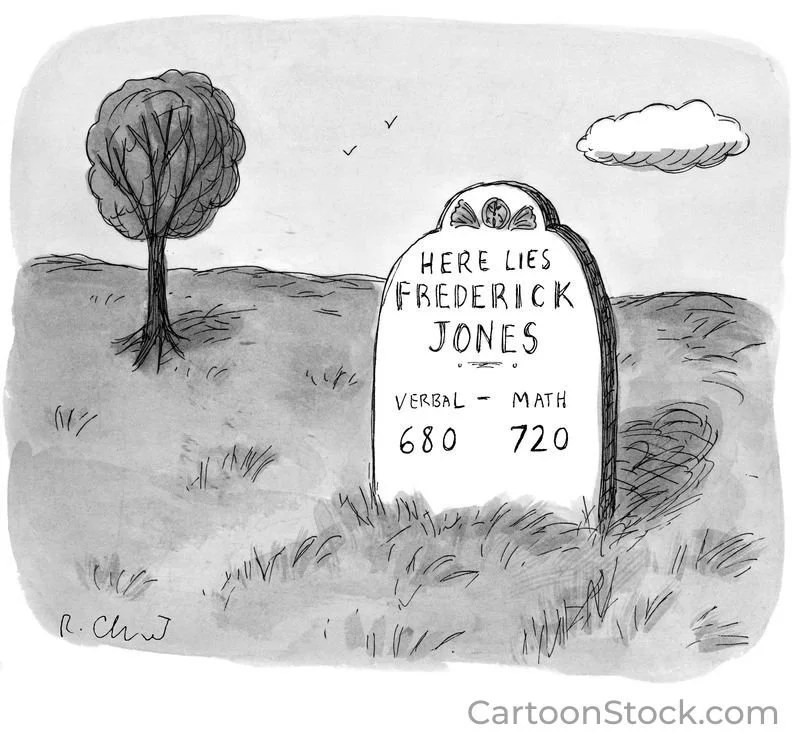
That raises a key question: what’s an optimal mindset for beating SAT reading questions?
Since the College Board builds every question to survive a hypothetical lawsuit, a good way to beat them is to think like a courtroom lawyer. Instead of guessing what feels right, we put all four answer choices on trial, interrogating every word and throwing out anything that isn’t backed by hard evidence in the text.
Once we adopt this lawyer mindset, SAT reading stops feeling like a guessing game and starts feeling like a skill that can be mastered. Of course, building the right mindset is just step one; real mastery comes from applying it again and again.
Want to get more reps in? Watch the video lesson below to see how this lawyer mindset applies to every type of SAT reading question.